Why RTLS Pilots Fail to Scale, and How to Fix It

Across manufacturing, RTLS pilots follow a strikingly consistent pattern: the pilot works, and then it goes nowhere. Anchors go up in one corner of one facility, tags report in, the dashboard lights up exactly the way it's supposed to, and six months later that same pilot is still running in that same corner. It never reaches the rest of the floor.
That's not a technology problem. Positioning accuracy is rarely what kills an RTLS project. What kills it is a specific, recognizable set of obstacles that show up right at the point where a successful test is supposed to become a funded, factory-wide system, obstacles that have nothing to do with whether the tags know where they are, and everything to do with whether the business can justify, afford, and operate the thing at scale.
This guide goes through those obstacles one at a time, how Pozyx is built to answer each one, and what it actually looked like when one manufacturer, Salco, pushed a pilot all the way through to a full, scaled deployment.
Why RTLS Pilots Don't Scale
Ask most teams why their RTLS pilot never expanded, and the answer usually isn't "the technology didn't work." It's some version of these four, and they tend to show up in roughly this order.
1. The Pilot Proves Accuracy, Not Business Value
A successful pilot almost always looks the same: a handful of anchors, a demo dashboard, and tags that show up exactly where they should. That's a legitimate proof of concept, it establishes that the physics works in this building, with this layout, with this much interference. But a dot moving across a floor plan is not what gets a six-figure rollout approved. Whoever controls that budget needs to see a specific operational number move: search time down, a production delay caught earlier, a shift's worth of manual monitoring eliminated. A pilot that only proves positioning accuracy never produces that number, because nothing downstream of the dashboard was built to use the data.
This is the gap between "the tags work" and "this changed how the floor runs," and it's also where a lot of RTLS vendors quietly stop, leaving the customer to build everything downstream of the dashboard themselves. Pozyx is built to close that gap as a whole platform, not a single feature: positioning connects directly to geofences, automated alerts, operational workflows, and reporting, so a tag crossing a boundary can trigger a real action instead of just updating a map. Part of what makes that practical is that Pozyx also ships the application layer on top of it, out of the box, a mobile app for search-and-find and asset linking, kiosk apps for forklifts and entrances, a mobile GPS/BLE scanner, so none of that has to be custom-built before a pilot can start producing a number worth showing to whoever controls the budget.
Watch the "RTLS in manufacturing" video where Samuel van de Velde, Founder and CTO of Pozyx sits together with Stijn Van de Velde, CEO of Gemba Systems, to talk through what RTLS looks like in practice: the problems it solves, the results customers have seen, and where the technology is headed.
2. The Infrastructure Cost Becomes Hard to Justify
Covering a small pilot area at full precision is affordable almost anywhere; it's a handful of anchors in one room. The math changes entirely once someone asks what it costs to cover the whole site at that same density, because cost scales with coverage, and a lot of RTLS architectures only have one setting: maximum precision, everywhere, all the time. That's the point where a finance conversation that looked easy during the pilot suddenly doesn't.
The reason Pozyx doesn't run into that wall as hard is that it doesn't force one setting. The platform supports accurate, approximate, and presence-only UWB positioning, and UWB positioning dense enough for centimeter accuracy needs meaningfully more anchors per square foot than a presence check does, often by close to an order of magnitude. So instead of pricing the whole factory at tool-crib precision, a deployment can put full accuracy only where a few centimeters actually changes a decision (a tool crib, an assembly cell, a collision-avoidance zone) and drop to a lighter, cheaper mode everywhere else, including zone-level BLE for broad warehouse coverage. In practice, that turns scaling into something that happens one area at a time, each area priced for what it actually needs, rather than one expensive all-or-nothing rollout.

Worth a specific callout: the EU is a real-world example of this exact density principle extending outdoors. A 2024 regulatory update (Implementing Decision (EU) 2024/1467) increased permitted indoor UWB transmission power and, for the first time, permitted certain outdoor UWB applications, so a European yard or dock can now get UWB-level precision in spots that used to be BLE-only by default elsewhere.
Entdecken Sie die Pozyx-Plattform
Die Pozyx-Plattform vereint Indoor- und Outdoor-Positionsdaten, um vollständige Transparenz über Assets, Automatisierung und standortbasierte Einblicke für Logistik und Fertigung zu ermöglichen.
Pozyx-Plattform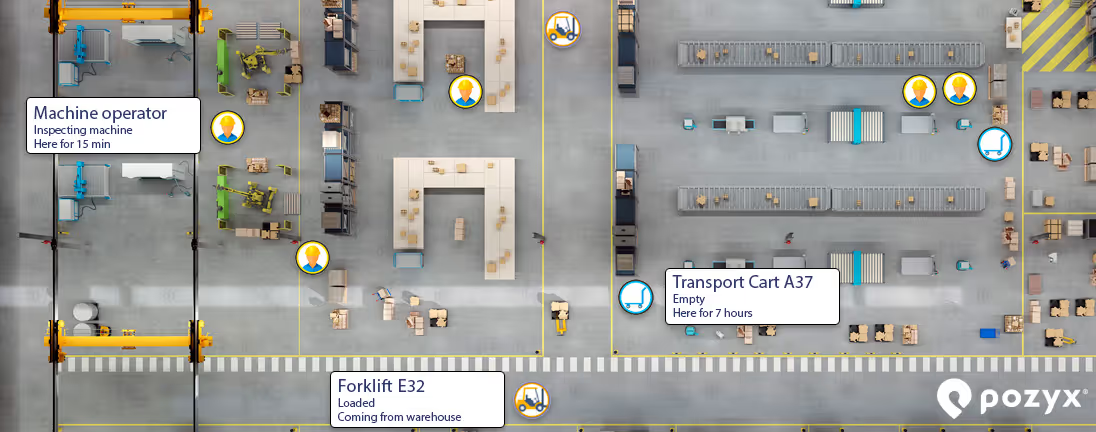
3. Location Data Stays Isolated From Operations
During a pilot, someone watches a dashboard. That's the whole workflow: a person checks a screen, notices something, acts on it. In production, that same location data has to reach the ERP, the MES, or an operator's device automatically, without a human in the loop watching for it, and that's a fundamentally different integration problem than the one the pilot solved. Every RTLS vendor that only ships a viewer application pushes that integration work entirely onto the customer, and it tends to show up as its own multi-month IT project per system connected, which is exactly the kind of cost that kills a scale-up business case even when the positioning itself is fine.
Pozyx's answer is to not make every connection a custom build. Location changes, geofence entries and exits, and tag-to-asset links are all exposed as structured events through the omlox Hub, an open, vendor-neutral standard rather than a Pozyx-only protocol, over standard HTTP, websocket, and MQTT APIs. A plant's ERP or MES can subscribe to those events directly, so when a tagged component crosses into a defined zone, the system of record updates the same way it would from a manual scan, just without anyone doing the scanning. That's a meaningfully smaller lift than building point-to-point integrations from scratch. It's not zero effort: the business-specific mapping, what a given zone-entry event is supposed to trigger in a specific ERP, still has to be configured for each customer's systems. But the reusable event layer underneath it doesn't get rebuilt every time.
4. The Pilot Doesn't Satisfy Production IT Requirements
A pilot can run off a laptop in the corner of an office, with one person who knows how to restart it if something breaks. A production deployment has to survive that person being on vacation. It needs a security review, defined access control, a backup and update process, and an agreed support model, the standard checklist any IT team runs before it will let a new system touch live operational data, and a lot of RTLS pilots were never built with that checklist in mind, which is precisely why they stall in IT review rather than in the warehouse.
Pozyx is built to clear that checklist rather than argue with it: local positioning, a Platform that can be hosted, run on-premise, or deployed in an isolated environment depending on what a customer's IT policy requires, single sign-on (SSO), and documented security and operational responsibilities that an IT team can actually review. One detail that comes up constantly in these reviews: the Platform doesn't require new dedicated physical hardware to run. It can be installed as a virtual machine inside infrastructure IT already manages, including VMware environments, which turns "where does this live" from an open question into something that fits the server provisioning process already in place.
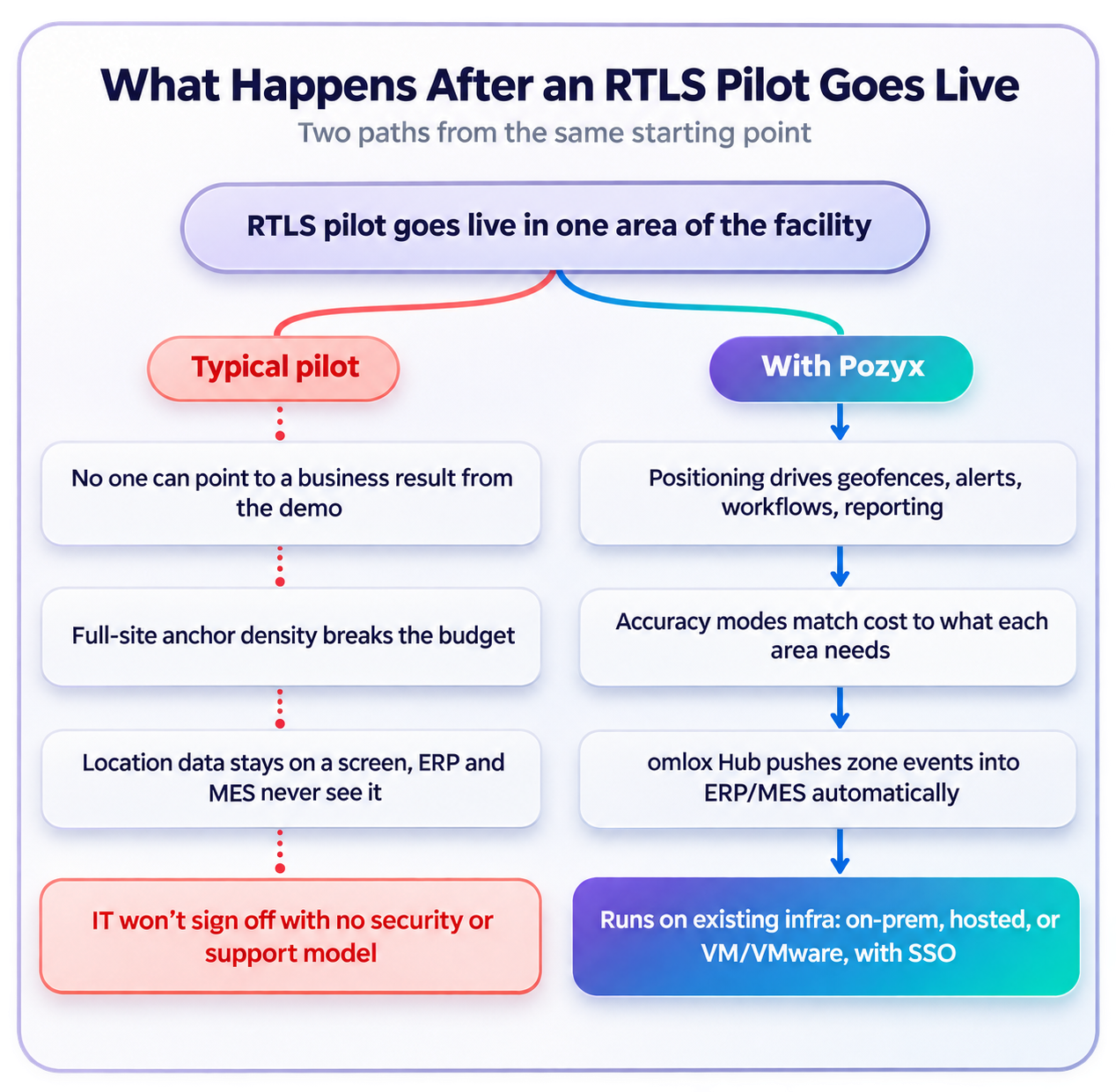
None of these four obstacles are really about whether RTLS works. They're about business value, deployment economics, and integration, the three things that decide whether a pilot gets funded, approved, and scaled, or quietly shelved. The chart below lays out what that difference looks like end to end.
Proof: How Salco Closed Its Own Visibility Gap
Salco, a Dutch manufacturer of tailor-made door solutions with more than 40 years in business, ran into a problem common to job-shop manufacturing: no two production runs look the same, which makes it nearly impossible to know, in the moment, where every order actually stands.
Production managers were walking the floor to piece together status updates, a method that was slow and depended heavily on one manager's personal knowledge of the line. It also made it difficult to calculate labor costs accurately, since nobody had a reliable way to measure how long each production step actually took.
“Today we do not know exactly the production times for each production step. Hence, we cannot know what the labor cost details are, where possible inefficiency can be found, and cannot control profitability on product level,” said Jan Heddes, General Manager at Salco.
Salco installed a Pozyx UWB RTLS across two buildings, using 22 fixed anchors and roughly 500 tags attached to product components, transport carts, and, in compliance with GDPR, anonymized operator badges. The Pozyx Platform was connected directly to Salco's ERP, so every tag automatically updated an order's status as it moved through defined production zones, with no manual scanning required.
The results, after implementation:
- More than 50% reduction in the delay between a production issue occurring and a manager noticing it
- More than 50% reduction in time spent physically monitoring the floor
- 20% better estimation of labor cost per product
- More than 20% reduction in time lost to bottlenecks and gaps in production flow
Read the full case-study here.
The Bottom Line
RTLS pilots don't fail to scale because the positioning stops working at a bigger site. They fail because business value, deployment economics, and integration were only ever solved for the test corner of the building, not the rest of it. Answer those three questions before the pilot gets to IT review, and the project that was stuck in one room has a real path to the whole floor.
As covered above, none of that requires building anything from scratch. The mobile app, kiosk apps, and open APIs that make a pilot's value visible on day one are the same ones a full deployment runs on later, there's no separate "production-grade" app layer to build.
Interested in deploying an RTLS? Talk to us!
Verfasst von
Benjamin Smith, MBA

Marketing-Spezialist bei Pozyx
Ben verbindet einen Hintergrund in Geschäftsentwicklung und Marktforschung mit einem starken Interesse an industrieller Technologie und Location Intelligence. Er begeistert sich dafür, zu erkunden, wie innovative Tracking-Technologien Effizienz, Transparenz und Entscheidungsfindung branchenübergreifend verbessern können.