The State of UWB in 2022 Trend 3

The State of UWB in 2022
7 Trends that shape the RTLS landscape
Trend #3 Semiconductors to choose from propagate technology adoption & avoid vendor lock-in
With the standardization maturing to guarantee future-proof solutions, it was Decawave (currently Qorvo) to release the first commercial UWB radio chip in 2013 to support the IEEE 802.15.4 - 2015 version, under which still resides the bulk of the currently shipped and used UWB devices today.
The most recent IEEE 802.15.4z, optimized for commercial UWB use and released at the end of 2020 is supported today by Qorvo’s new generation chipset and by NXP. Additional semiconductor vendors are ready to complete the list: Apple, producing its own U1 UWB chips (the “U” stands for UWB), ST Micro, and imec have all invested heavily in the development of UWB chips, which further confirms that UWB is the rising star in the firmament.
UWB is on the verge of becoming the next essential component technology, like GPS, WiFi and Bluetooth before it. Already shipping in millions of smartphones and cars, and across more than 40 other verticals, UWB is enabling accurate indoor location services, secure communications, context-aware user interfaces and advanced analytics, making it ideally suited to Industry 4.0 applications.
Eric Creviston, President of Qorvo
It is clear that the landscape of UWB chips available for commercial use is rapidly expanding. Each of the vendors has developed radio chips to support specific IEEE 802.15.4 standard versions and the different standard alliances (applications) that operate in different communication channels. The succeeding chipset product development cycles result in lower power consumption, smaller form-factor, and support for a broader range of features.
Technologies will never become globally successful when based on an exclusive offering. The industry adoption is fueled by the variety of semiconductor offerings to choose from to allow competition (on specs and features) to avoid the much-loathed vendor lock-in and to allow future interoperability between different UWB devices. And obviously, as the production of UWB chips continues to ramp up over time it holds the promise of a lower price.
Learn more in the eBook and read the first chapters
Download the pdf for better readability and for future reference
And get bonus content with quotes from industry leaders & infographics
Découvrez la plateforme Pozyx
La plateforme Pozyx regroupe les données de positionnement intérieures et extérieures pour fournir une visibilité complète des actifs et des enseignements basées sur la localisation au bénéfice de la logistique et la fabrication. Il facilite le contrôle des entrepôts et des stocks, assure le suivi des emballages et des commandes retournables et réduit les coûts liés à la perte d'actifs.
Plateforme Pozyx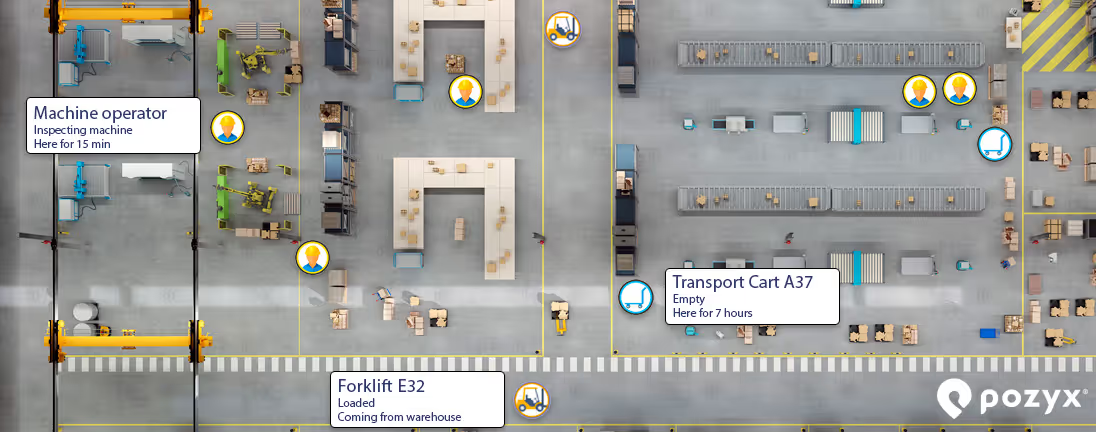
7 trends are key drivers for UWB success
eBook Content
Introduction & short history of UWB - analyst predictions
#1 Chip interoperability is guaranteed through a solid IEEE standard
#2 Global regulations enable worldwide coverage
#3 Semiconductors to choose from propagate adoption & avoid vendor lock-in
#4 Application standardization is secured by alliances & consortiums
#5 UWB is the growing star in the center of active research
#6 Mature RTLS deployment tools bolster quick and reliable RTLS solutions
#7 Growing RTLS ecosystem boosts application confidence
Interested in all 7 trends?
Written by
Elly Schietse

CMO at Pozyx
Experienced director with a demonstrated history of working with global technology companies, in IoT, IT, semiconductor and high-tech industry. Long track record in Management, Marketing, Quality (ISO 9001 & ISO 14001) & ISMS (ISO 27001).