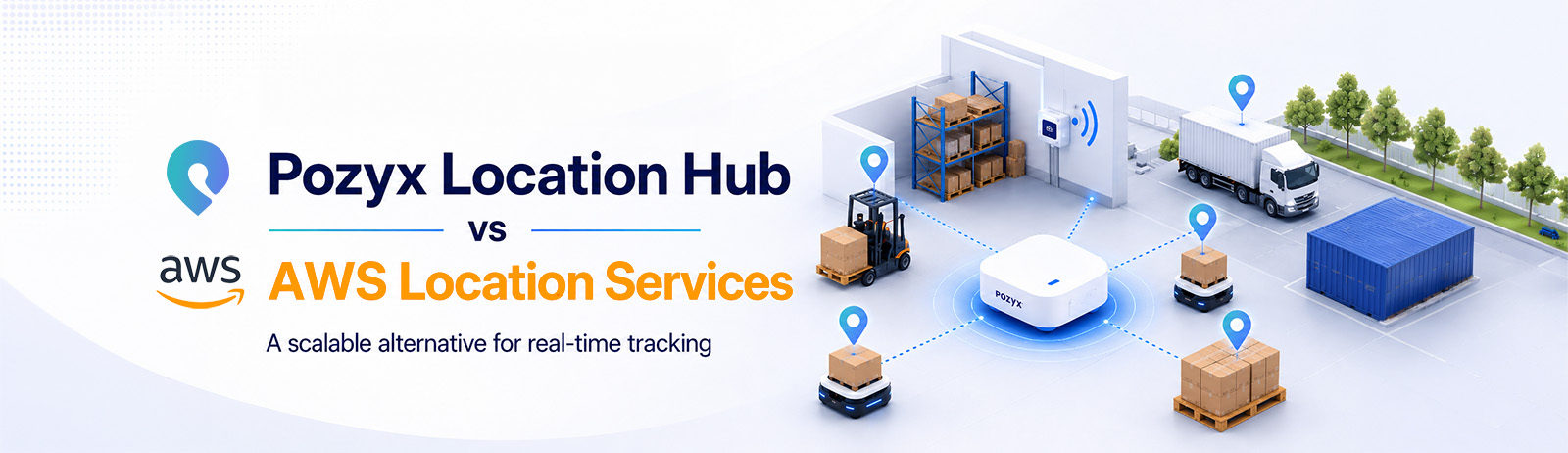
Le Pozyx Location Hub comme alternative à Amazon Location Services

Résumé
Amazon Location Service, souvent abrégé en ALS, est un service AWS qui ajoute des fonctionnalités de cartographie, de recherche de lieux, de routage, de géocodage, de suivi et de géorepérage aux applications. Amazon Location Service est conçu pour des applications à faible fréquence, axées sur l’extérieur. Il fonctionne bien lorsque les actifs ne remontent des informations qu’occasionnellement et lorsque les évaluations de géorepérage sont peu fréquentes. Mais pour le suivi en temps réel ou industriel, le modèle de tarification à l’événement d’AWS devient extrêmement coûteux.
Le Pozyx Location Hub offre une alternative évolutive à Amazon Location Services, particulièrement adaptée aux équipes logicielles internes d’entreprise qui souhaitent créer leurs propres applications, tableaux de bord, workflows ou analyses personnalisés sans être liées à une tarification imprévisible par événement. Il fournit un hub omlox entièrement conforme et étendu pour un suivi fluide en intérieur et en extérieur, un comportement avancé de géorepérage, un suivi multi-technologies, un service de cartographie par tuiles et un accès sécurisé aux données via les API HTTP omlox et les flux MQTT. La solution Pozyx offre les fonctionnalités nécessaires au suivi industriel continu à un coût généralement inférieur de deux ordres de grandeur à celui d’Amazon Location Service, tout en conservant des pratiques de sécurité alignées sur les standards cloud d’AWS.
Amazon Location Service vs Pozyx Location Hub
| Sujet | Amazon Location Service | Pozyx Location Hub |
|---|---|---|
Le plus adapté pour |
Suivi à faible fréquence, principalement en extérieur |
Suivi industriel continu en intérieur et en extérieur |
Modèle de tarification |
Tarification à l’événement |
Tarification prévisible basée sur la plateforme |
Suivi en intérieur |
Limité |
Conçu pour les environnements intérieurs, extérieurs et hybrides |
Géorepérage |
Évaluations de géorepérage dans le cloud |
Géorepérage industriel avec gestion de la fiabilité et zones de tolérance |
Intégration |
Services et API natifs AWS |
API HTTP omlox et MQTT |
Modèle de données |
Ressources de localisation AWS |
Modèle standardisé de hub omlox |
Prise en charge des cartes |
Services de cartographie extérieure |
Cartes intérieures, plans multi-étages, tuiles vectorielles |
Flexibilité de déploiement |
Service géré par AWS |
Service géré par Pozyx, ou auto-hébergé |
Comportement des coûts à haute fréquence |
Les coûts augmentent à chaque mise à jour |
Le suivi à haute fréquence reste prévisible |
Pourquoi Amazon Location Service devient coûteux pour le suivi en temps réel
Amazon Location Service facture chaque événement de localisation. Chaque mise à jour entraîne deux opérations facturables : une « position écrite » et une « position évaluée ». Cela convient pour des scénarios à faible fréquence, mais cela ne tient plus pour tout système où les appareils remontent des données fréquemment, où le temps réel est requis, ou lorsque le suivi en intérieur et le comportement précis des zones sont importants.
Exemple de tarification réel : 1 000 appareils avec 1 mise à jour par minute
Un appareil qui remonte une information une fois par minute envoie 1 440 mises à jour par jour. Pour 1 000 appareils, cela devient :
- 1 440 000 mises à jour par jour
- Environ 43,2 millions de mises à jour par mois
Chaque mise à jour est facturée deux fois.
| Composant de coût | Événements mensuels | Coût mensuel estimé |
|---|---|---|
API de suivi |
43,2 millions d’événements |
1 080 USD |
API de géorepérage |
43,2 millions d’événements |
2 592 USD |
Total |
86,4 millions d’événements facturés |
3 672 USD par mois |
Cela équivaut à environ 3,67 USD par appareil et par mois.
Cela n’inclut toujours pas des coûts tels que :
- Connectivité
- Ingestion IoT
- Stockage
- Charges de calcul
- Tableaux de bord et analyses
Si la fréquence de mise à jour passe à toutes les 10 secondes, le coût est multiplié par six et dépasse souvent 20 USD par appareil et par mois. Dans de nombreux déploiements, le prix global peut atteindre des dizaines de dollars par traceur et par mois, rendant le suivi continu économiquement irréalisable.
C’est la limite structurelle du modèle tarifaire d’ALS : plus la fréquence est élevée, plus le coût grimpe.
Découvrez la plateforme Pozyx
La plateforme Pozyx regroupe les données de positionnement intérieures et extérieures pour fournir une visibilité complète des actifs et des enseignements basées sur la localisation au bénéfice de la logistique et la fabrication. Il facilite le contrôle des entrepôts et des stocks, assure le suivi des emballages et des commandes retournables et réduit les coûts liés à la perte d'actifs.
Plateforme Pozyx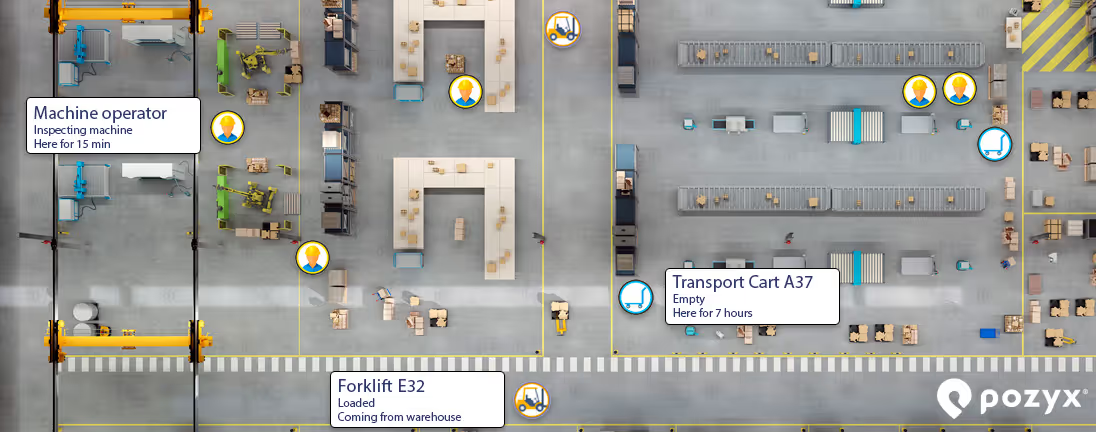
Le Pozyx Location Hub : conçu autour du standard omlox hub
Le Pozyx Location Hub adopte l’approche inverse. Au lieu de facturer à l’événement, il est optimisé pour un suivi industriel continu et à haute fréquence tout en gardant des coûts prévisibles. Il repose sur un hub omlox entièrement conforme, qui sert de colonne vertébrale unifiée pour toutes les données de localisation au sein d’un site ou d’un déploiement multi-sites.
Ce que permet le hub omlox
Dans l’implémentation Pozyx, le hub omlox fournit un modèle standardisé et interopérable pour toutes les technologies de suivi. Il harmonise les positions provenant des systèmes de localisation UWB, des balises BLE, des traceurs GPS, des systèmes RFID et de nombreux autres. Chaque fournisseur de localisation transmet ses données au hub omlox, qui transforme ces positions en un système de coordonnées global commun. Cela permet aux systèmes d’entreprise d’exploiter les localisations de manière cohérente, sans connaître l’origine ni le type du traceur.
Le comportement de géorepérage suit le standard omlox et est encore amélioré par Pozyx. Le Location Hub prend en compte la fiabilité de la localisation, applique des zones de tolérance et évite les déclenchements erronés d’entrée ou de sortie lorsque les signaux sont bruités. Le résultat est un comportement d’événements stable, même dans des environnements industriels complexes.
API HTTP omlox et MQTT : une intégration fluide pour les équipes d’entreprise
Le Pozyx Location Hub expose des interfaces de données claires et standardisées :
- API HTTP omlox pour interroger les positions, géorepérages, objets suivis, zones et métadonnées
- Flux MQTT pour diffuser en temps réel les mises à jour de localisation et les événements vers les systèmes internes
Ces deux interfaces rendent le hub Pozyx extrêmement accessible pour les équipes logicielles internes d’entreprise. Elles peuvent l’intégrer à leur WMS, ERP, MES, jumeau numérique ou applications d’analyse personnalisées sans dépendre de SDK propriétaires ni de pipelines cloud coûteux basés sur des événements.
MQTT permet en particulier de diffuser des mises à jour de localisation à haute fréquence avec une surcharge minimale, et sans payer à l’événement.
Aller au-delà du hub omlox
Enrichissement des données
Pozyx étend le hub omlox standard avec une modélisation d’actifs plus riche et un enrichissement automatisé des données.
Les modèles d’objets suivis permettent aux organisations de définir des types d’actifs cohérents avec des champs de métadonnées adaptés à leurs workflows. L’enrichissement des données ajoute le temps de présence, la classification des mouvements, la détection sémantique des sites et des bâtiments, ainsi que des informations contextuelles supplémentaires qui simplifient la logique en aval. Ces améliorations rendent la plateforme directement exploitable pour les opérations sans créer de couches supplémentaires de traitement des données.
Gestion des cartes et service de cartographie par tuiles
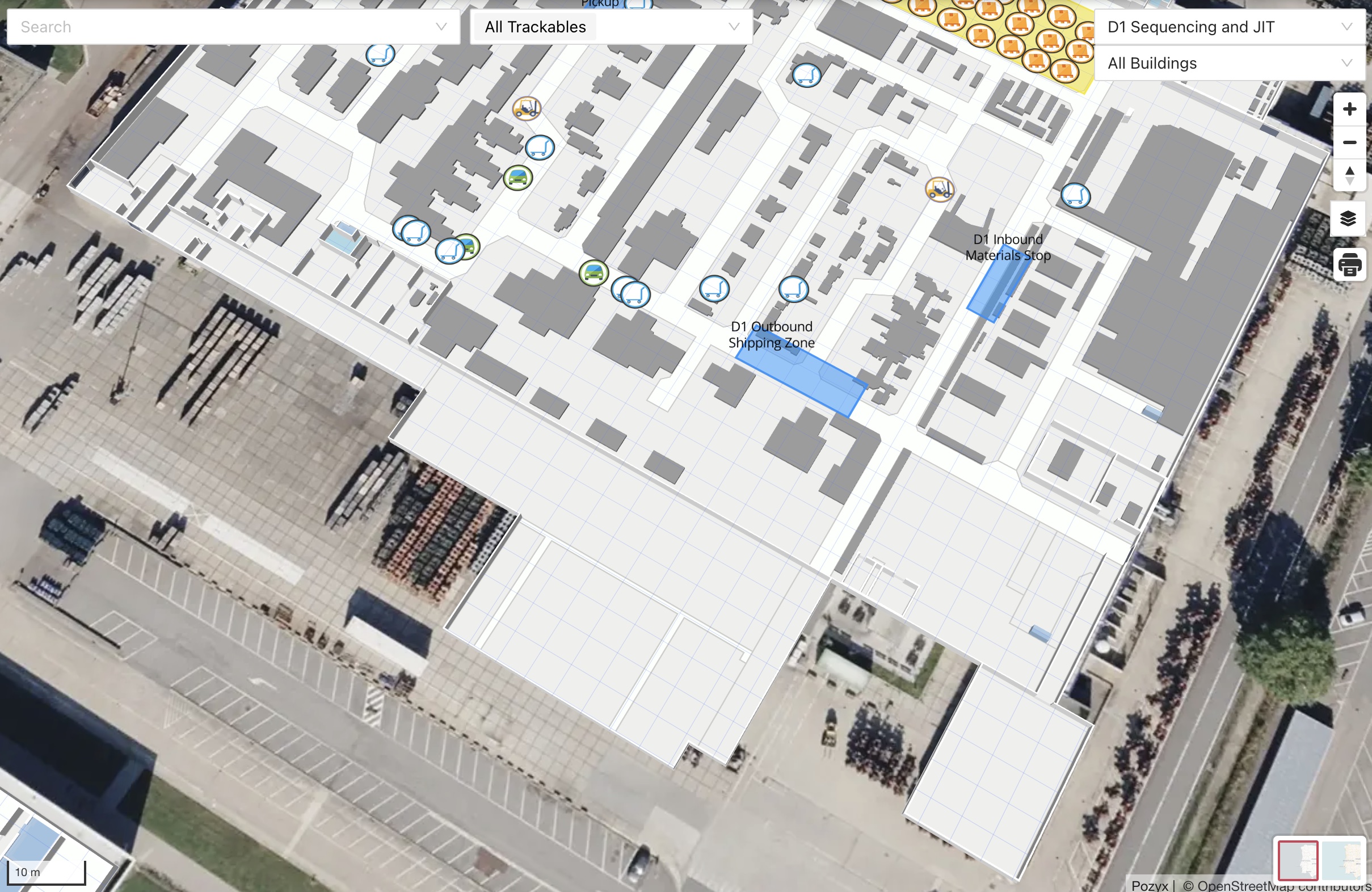
Un élément clé du Pozyx Location Hub est son service de cartographie par tuiles intégré. Pozyx héberge des cartes intérieures, des structures de bâtiments et des plans multi-étages, et les diffuse sous forme de tuiles vectorielles. Cela permet un rendu haute performance à la fois dans la plateforme Pozyx et dans des applications tierces qui ont besoin de données cartographiques cohérentes et évolutives.
Les cartes intérieures et extérieures, les plans d’entrepôt et les plans issus de CAO deviennent tous partie d’un environnement unifié, ce qui est essentiel pour les déploiements industriels où le contexte compte.
Sécurité dès la conception : comparable à la sécurité d’ALS
Le Pozyx Location Hub suit des pratiques de sécurité modernes similaires à celles qu’attendent les entreprises des services AWS. Cela inclut des mécanismes d’authentification sécurisés, des contrôles d’accès API robustes, des communications chiffrées et des options de déploiement isolées.
Les clients peuvent utiliser Pozyx dans :
- Un environnement cloud sécurisé géré par Pozyx
- Un environnement auto-hébergé sous contrôle total de l’entreprise
Cette flexibilité facilite la conformité, les audits et la maîtrise complète des données et de l’infrastructure pour les équipes d’entreprise soucieuses de la sécurité.
Idéal pour les équipes logicielles internes d’entreprise
De nombreuses entreprises souhaitent créer leurs propres outils sur une base de localisation fiable, plutôt que d’être liées à un service cloud fermé qui facture à l’événement.
Pozyx est particulièrement adapté aux équipes logicielles d’entreprise qui souhaitent :
- Intégrer la localisation à leurs systèmes métier existants
- Créer des tableaux de bord personnalisés et des workflows opérationnels
- Traiter des données de localisation en temps réel via MQTT sans hausse des coûts
- Travailler avec une API omlox standardisée plutôt qu’avec des formats propriétaires de fournisseurs
- Conserver un contrôle total sur le déploiement et la propriété des données
- Éviter une facturation cloud imprévisible basée sur les événements
Pozyx devient un service interne stable plutôt qu’un centre de coûts cloud variable.
Prévisibilité des coûts à grande échelle
Comme Pozyx ne facture pas à l’événement, les organisations peuvent augmenter la fréquence de suivi, le nombre d’actifs ou le nombre de géorepérages sans mauvaise surprise financière. Les applications de sécurité, la détection de collisions et les workflows à haute fréquence restent abordables et prévisibles.
Dans des projets réels, Pozyx permet souvent de réduire les coûts de deux ordres de grandeur par rapport à Amazon Location Service pour des charges de travail similaires.
La place du Pozyx Location Hub dans la plateforme Pozyx plus large
Le Pozyx Location Hub est le cœur de la plateforme Pozyx, mais il s’inscrit dans un écosystème plus large qui ajoute de la valeur par couches au-dessus du positionnement en temps réel. La plateforme comprend un environnement d’analytique complète pour les trajets historiques, les heatmaps et les insights opérationnels, aidant les équipes à comprendre les schémas de déplacement et à optimiser les processus.
Une couche d’automatisation fournit des workflows basés sur des règles qui peuvent déclencher des alertes, s’intégrer aux systèmes d’entreprise ou rationaliser les opérations courantes à partir de signaux fiables de géorepérage et d’événements issus du Location Hub. Une application mobile prend en charge les activités quotidiennes telles que le scan, l’étiquetage et la navigation sur site.
L’ensemble fonctionne dans un cadre d’administration de niveau entreprise pour les rôles utilisateurs, les sauvegardes, les diagnostics et la gestion des intégrations. Ainsi, le Location Hub devient la base d’une plateforme industrielle de localisation complète, avec des outils d’analyse, d’automatisation et d’exploitation disponibles au fur et à mesure que les besoins évoluent.
Conclusion
Amazon Location Service convient au suivi extérieur à faible fréquence, mais son modèle de facturation devient trop coûteux pour les scénarios en temps réel. Dès que les appareils remontent des données fréquemment ou nécessitent des géorepérages en intérieur, les coûts augmentent rapidement.
Le Pozyx Location Hub offre une alternative sécurisée, évolutive et prévisible, construite autour du standard omlox. Il fournit un suivi unifié en intérieur et en extérieur, un géorepérage fiable, une gestion globale des coordonnées, un service de cartographie par tuiles haute performance et une intégration via les API HTTP omlox et les flux MQTT. Des extensions comme les modèles d’objets suivis et l’enrichissement des données le rendent pratique pour les opérations industrielles réelles.
Pour les équipes logicielles internes d’entreprise qui recherchent une base économique et conviviale pour les développeurs afin de créer leurs propres applications, Pozyx offre une solution puissante et pérenne à une fraction du coût d’ALS.
Si vous souhaitez démarrer, contactez-nous pour obtenir un kit ou une version d’essai, la documentation API et plus d’informations :
Rédigé par
Samuel Van de Velde

CTO et co-fondateur chez Pozyx
Samuel est ingénieur électricien avec un fort intérêt pour la technologie de localisation. Compétent en entrepreneuriat, prise de parole en public, gestion de produit, Internet des objets (IoT) et apprentissage automatique. Après avoir obtenu son diplôme en 2010, il a rejoint le Département des télécommunications et du traitement numérique de l'information (TELIN) pour poursuivre un doctorat sur le sujet de la localisation collaborative en intérieur. En 2015, il a fondé la spin-off Pozyx issue de cette recherche.