Le Retail Worker Safety Act de New York

Introduction
Un employé du commerce travaillant sur la surface de vente d’un grand magasin à Buffalo dispose d’un éventail très limité d’options lorsqu’une confrontation liée à un vol à l’étalage devient agressive ou qu’un client se montre menaçant. Crier pour appeler un responsable. Tendre la main vers un téléphone qui se trouve peut-être dans un casier. Ou ne rien dire et espérer que la situation se calme d’elle-même. Les législateurs de l’État de New York ont décidé que cette dernière option ne devait jamais être la seule, et à partir du 1er janvier 2027, elle ne le sera plus. Chaque employeur du commerce comptant 500 employés ou plus à l’échelle de l’État sera légalement tenu de fournir à chaque travailleur du commerce un moyen d’appeler à l’aide sans dire un mot.
Il s’agit de l’exigence du bouton de réponse silencieuse prévue par le Retail Worker Safety Act de New York (Labor Law Section 27-e), qui s’ajoute à une obligation de politique de prévention de la violence au travail et de formation déjà entrée en vigueur le 2 juin 2025. Pour les enseignes de grande surface, les magasins adjacents à des zones de distribution et les chaînes d’épicerie opérant sur plusieurs étages et dans plusieurs réserves, la question de conformité n’est pas vraiment « avons-nous besoin d’un bouton ? ». C’est plutôt « comment nous assurer que le bouton permet réellement d’obtenir de l’aide au bon endroit, rapidement ? »
C’est sur cette deuxième question que la plupart des discussions autour des boutons d’alerte silencieuse s’enlisent. Un dispositif qui envoie une alerte discrète ne fait que la moitié du travail. Il faut encore savoir où se trouve l’employé. Dans un magasin de 3 700 m² avec un entrepôt à l’arrière, l’écart entre « alerte envoyée » et « aide localisée » est précisément l’endroit où la technologie de localisation en temps réel prend toute sa valeur dans la discussion sur la conformité.

Qu’est-ce que le New York Retail Worker Safety Act ?
Le Retail Worker Safety Act a été promulgué en septembre 2024, puis modifié en février 2025 afin de clarifier son champ d’application et son calendrier. Il s’applique aux « retail employers », définis largement comme des entreprises qui vendent des biens de consommation directement au public, avec quelques exceptions pour les très petites structures. La loi comporte deux volets de conformité distincts, avec deux échéances distinctes.
Le premier volet, déjà en vigueur depuis le 2 juin 2025, exige des employeurs du commerce comptant 10 employés ou plus dans l’État de New York qu’ils adoptent une politique écrite de prévention de la violence au travail, forment les employés à reconnaître et à gérer la violence au travail, et conservent les registres de cette formation. Cette obligation s’applique à un ensemble de détaillants bien plus large que l’exigence du bouton.
Le second volet est celui qui attire le plus l’attention des équipes opérations et facilities : à partir du 1er janvier 2027, les employeurs du commerce comptant 500 employés ou plus à l’échelle de l’État devront fournir à chaque employé du commerce un bouton de réponse silencieuse. Le libellé légal est précis. Le bouton doit permettre à un employé de « demander une assistance immédiate à un agent de sécurité, un responsable ou un superviseur » lorsqu’il se trouve dans les locaux. La version initiale du projet de loi de 2024 utilisait le terme « panic button » et exigeait une ligne directe vers les forces de l’ordre pour les employeurs comptant 500 employés ou plus à l’échelle nationale. L’amendement de 2025 signé par la gouverneure Hochul a assoupli ces deux dispositions : le seuil est passé à un décompte d’employés à l’échelle de l’État, et la réponse peut être acheminée vers du personnel sur site plutôt que directement vers le 911.
Point crucial : la loi amendée n’exige pas de nouveau matériel dédié. Un dispositif portable, une application mobile ou un bouton fixe peuvent tous satisfaire à l’exigence, comme l’a confirmé l’orientation du Department of Labor de New York. Cette flexibilité est une bonne nouvelle pour les détaillants, mais elle signifie aussi que le marché va bientôt se remplir d’options de conformité d’une qualité très variable. Un bouton qui déclenche une alerte dans un groupe de discussion est techniquement conforme. Il est aussi presque inutile en cas d’urgence si personne ne peut savoir de quelle allée, parmi quarante, provient l’alerte.
Pourquoi c’est important : les chiffres derrière la loi
Les législateurs n’ont pas rédigé ce texte dans le vide. Le commerce de détail est devenu sensiblement plus dangereux pour les personnes qui y travaillent, et la tendance évolue dans la mauvaise direction depuis plusieurs années.
- Le poids économique du commerce de détail : le secteur contribue à hauteur d’environ 5 300 milliards de dollars par an au PIB américain et soutient plus d’un emploi sur quatre aux États-Unis, selon le Loss Prevention Research Council (LPRC). Cette ampleur explique précisément pourquoi les législateurs ont traité la sécurité des travailleurs du commerce comme une priorité à l’échelle de l’État plutôt que comme un problème magasin par magasin.
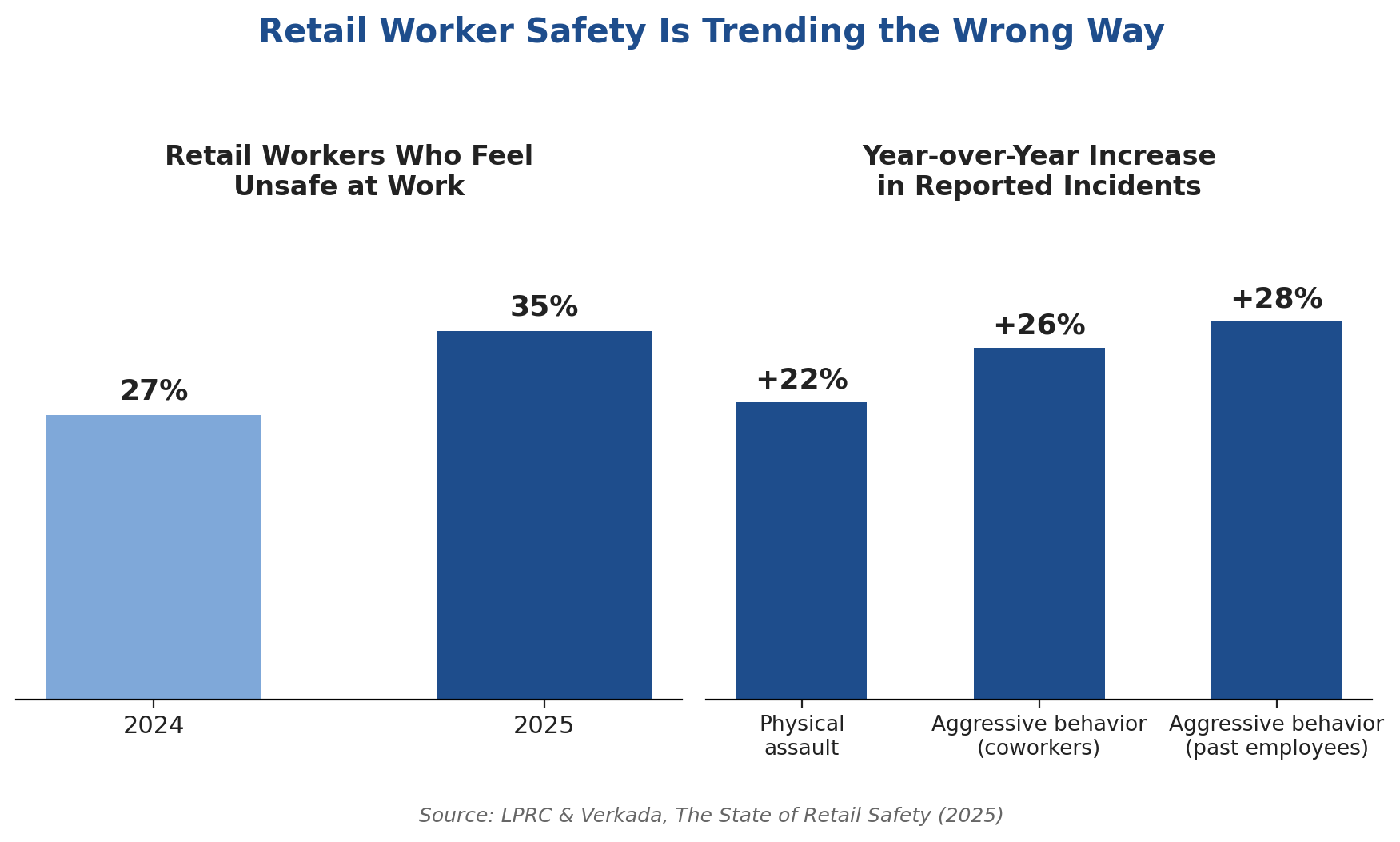
- Le sentiment d’insécurité augmente : plus d’un travailleur du commerce sur trois, soit 35 %, a déclaré s’être senti en insécurité au travail en 2025, contre 27 % l’année précédente, selon le rapport State of Retail Safety du LPRC et de Verkada.
- Les agressions augmentent : les signalements d’agressions physiques contre les travailleurs du commerce ont augmenté de 22 % d’une année sur l’autre dans la même étude, tandis que les comportements agressifs de la part de collègues et d’anciens employés ont progressé respectivement de 26 % et 28 %.
- Les préoccupations de sécurité alimentent le turnover : 52 % des travailleurs du commerce disent être susceptibles de quitter leur emploi actuel dans les 12 mois en raison de préoccupations liées à leur sécurité personnelle, et ce chiffre grimpe à 53 % parmi les travailleurs ayant déjà subi un incident violent au travail.
- Le coût humain est national : 470 travailleurs sont morts à la suite d’agressions sur le lieu de travail en 2024, selon l’analyse du National Safety Council des données du Bureau of Labor Statistics.
Mettez ces chiffres côte à côte et une tendance se dessine : les incidents de sécurité augmentent, les travailleurs le remarquent, et le turnover suit de près. Pour un employeur du commerce comptant plus de 500 employés, le bouton de réponse silencieuse n’est pas seulement une case juridique à cocher. C’est un levier direct de rétention dans un secteur déjà soumis à de fortes tensions sur la main-d’œuvre.
Comment fonctionne réellement l’exigence du bouton de réponse silencieuse
La loi laisse place à trois grandes catégories de dispositifs admissibles, et chacune comporte de véritables compromis que les équipes opérations du commerce devraient évaluer avant de signer un contrat.
| Type de bouton | Fonctionnement | Principale limite |
|---|---|---|
Bouton matériel fixe |
Installé aux caisses ou à des postes fixes |
Inutile si l’employé ne se trouve pas à proximité |
Application sur téléphone |
L’employé déclenche l’alerte depuis un appareil professionnel ou personnel |
Dépend du fait que le téléphone soit à portée de main, chargé et déverrouillé |
Dispositif portable |
Fixé à un cordon, un bracelet ou une ceinture |
Doit être associé à un système qui sait où se trouve réellement la personne qui le porte |
Remarquez le schéma. Chaque option de ce tableau résout la question « comment l’employé envoie-t-il l’alerte ? ». Aucune, à elle seule, ne résout la question « comment aide-t-elle à trouver l’employé ? ». Un responsable de magasin qui lit un message disant « l’employé n° 4521 a besoin d’aide » doit encore fouiller le bâtiment. Dans une confrontation en cours, ce temps de recherche représente l’intégralité du risque.
C’est l’élément du puzzle de conformité que la plupart des argumentaires commerciaux passent sous silence, et c’est précisément ce que les systèmes de localisation en temps réel (RTLS) ont été conçus pour résoudre.
Découvrez la plateforme Pozyx
La plateforme Pozyx regroupe les données de positionnement intérieures et extérieures pour fournir une visibilité complète des actifs et des enseignements basées sur la localisation au bénéfice de la logistique et la fabrication. Il facilite le contrôle des entrepôts et des stocks, assure le suivi des emballages et des commandes retournables et réduit les coûts liés à la perte d'actifs.
Plateforme Pozyx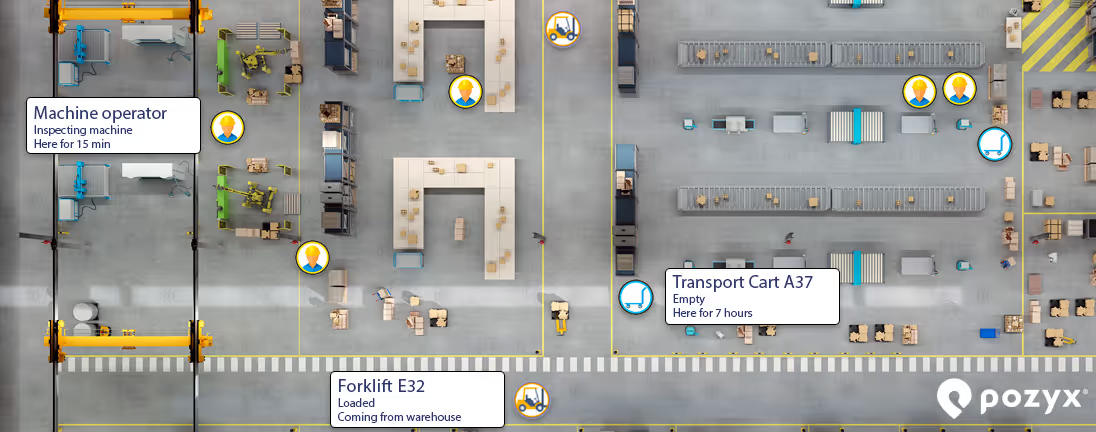
La preuve que cela fonctionne à grande échelle
Pozyx n’a pas conçu sa plateforme de positionnement spécifiquement pour la conformité dans le commerce de détail. Elle a été pensée pour les ateliers de production, les entrepôts et les centres de distribution, ces grands espaces intérieurs complexes où savoir exactement où se trouve une personne ou un actif, en temps réel, change la vitesse à laquelle une entreprise peut réagir à un problème. Cet historique compte ici, car le défi technique sous-jacent est identique : un grand espace intérieur, des personnes et des actifs qui s’y déplacent, et un besoin de données de localisation instantanées et précises dès qu’un problème survient.
Chez Salco Industrial Doors, le système de localisation en temps réel de Pozyx a offert à l’atelier une visibilité qu’il n’avait jamais eue auparavant. « La mise en œuvre de Pozyx sur notre atelier a changé la donne », a déclaré Horia Iancu, Process Engineer chez Salco. « L’adoption à l’échelle de l’entreprise a été exceptionnelle, et c’est rapidement devenu indispensable, en faisant gagner un temps précieux à tout le monde au quotidien. » Dans l’ensemble des déploiements industriels de Pozyx, les clients ont signalé une baisse de 30 % des incidents sur le lieu de travail et une réduction de 50 % du temps de recherche des actifs, soit exactement le même problème de recherche et de localisation auquel un responsable de magasin est confronté lorsqu’une alerte silencieuse arrive sans indication de position.
Le commerce de détail de grande surface, précisément le segment visé par cette loi avec son seuil de 500 employés, ressemble structurellement beaucoup aux entrepôts et aux lignes de production déjà servis par Pozyx : vastes plans de vente, réserves, plusieurs niveaux et personnel réparti par zones plutôt que regroupé à une seule caisse. C’est cette similitude qui permet à la même technologie de positionnement de passer sans difficulté de la sécurité en usine à la sécurité dans le commerce.
Comment Pozyx répond à cette exigence
L’approche de Pozyx face à l’exigence du bouton de réponse silencieuse commence avec le matériel que la plateforme commercialise déjà : le Wearable Interactive UWB Tag, un petit dispositif alimenté par batterie, porté sur un bracelet, un cordon ou une pince de ceinture, avec un bouton programmable et une LED d’état intégrés. Positionné grâce à la technologie ultra-large bande, il offre une précision de localisation jusqu’à 10 centimètres en intérieur, et l’autonomie de la batterie s’étend généralement sur plusieurs années selon la fréquence de mise à jour, de sorte qu’il ne s’agit pas d’un appareil supplémentaire que les employés doivent penser à recharger chaque soir.
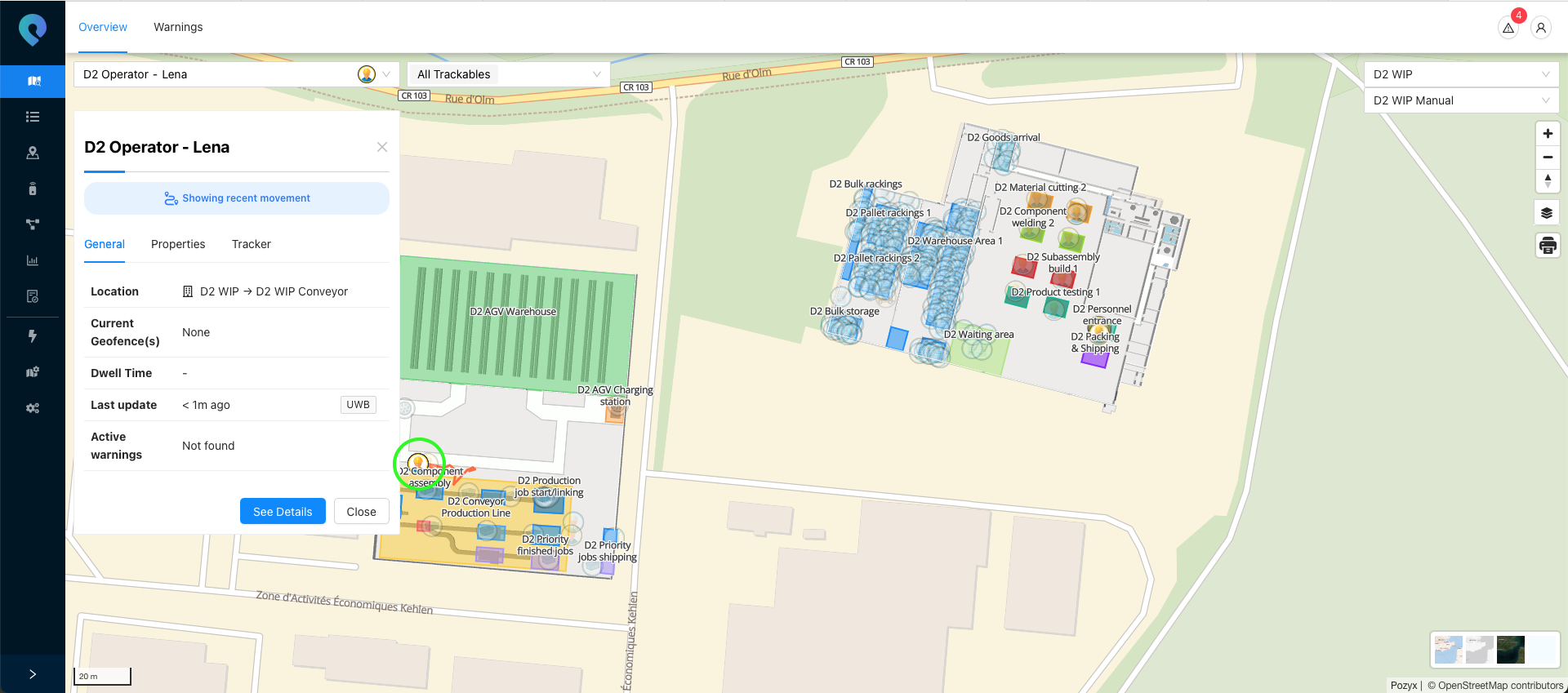
Lorsqu’un employé appuie sur le bouton, l’alerte ne se contente pas de déclencher une notification. Elle déclenche une notification accompagnée d’une localisation exacte, acheminée via le moteur de déclencheurs basés sur la localisation de Pozyx, qui peut être configuré pour alerter un responsable, un superviseur ou la sécurité sur site exactement comme l’exige la loi, avec la précision d’une zone ou d’une allée spécifique plutôt que « quelque part dans le bâtiment ». C’est la différence entre une case de conformité cochée et un système qui amène réellement un responsable au bon endroit en quelques secondes.
Trois éléments font de cette réponse une solution sensiblement différente d’un simple bouton d’alerte :
- Précision : une précision intérieure de dix centimètres signifie que l’alerte indique aux intervenants quelle allée, quelle porte de quai ou quelle zone de réserve viser, et pas seulement quel bâtiment.
- Aucune nouvelle dette d’infrastructure : Pozyx fonctionne avec des ancres longue portée en chaînage, de sorte que les magasins de grande surface n’ont pas besoin de recâbler le bâtiment pour le déployer.
- Intégration ouverte : l’API ouverte de la plateforme se connecte aux systèmes de sécurité, aux radios et au contrôle d’accès existants, de sorte que le bouton de réponse silencieuse devient un signal supplémentaire au sein d’un système que les détaillants utilisent déjà, et non une application séparée que personne ne consulte.
Rien de tout cela n’oblige un détaillant à remplacer sa pile de sécurité existante. Cela consiste à superposer une intelligence de localisation à n’importe quel mécanisme d’alerte déjà en place dans le magasin, ou prévu pour 2027.
Conclusion
Le Retail Worker Safety Act de New York fixe une échéance claire : le 1er janvier 2027, tous les employeurs du commerce comptant 500 employés ou plus à l’échelle de l’État devront offrir au personnel de première ligne un moyen rapide et discret d’appeler à l’aide. Le bouton lui-même est la partie la plus simple. La vraie question à bien résoudre est de savoir si ce bouton indique à quelqu’un où aller une fois qu’il est actionné, et c’est là que se trouve le véritable avantage.
Trois éléments rendent la réponse de Pozyx sensiblement différente d’un simple bouton d’alerte :
- Précision : une précision intérieure de dix centimètres signifie que l’alerte indique aux intervenants quelle allée, quelle porte de quai ou quelle zone de réserve viser, et pas seulement quel bâtiment.
- Installation rapide et peu perturbatrice : les ancres Pozyx sont longue portée et se chaînent entre elles, de sorte qu’un magasin de grande surface peut mettre le système en service en quelques jours, et non en plusieurs mois, sans travaux ni interruption sur la surface de vente.
- Intégration ouverte : l’API ouverte de la plateforme se connecte aux systèmes de sécurité, aux radios et au contrôle d’accès existants, de sorte que le bouton de réponse silencieuse devient un signal supplémentaire au sein d’un système que les détaillants utilisent déjà, et non une application séparée que personne ne consulte.
Rien de tout cela n’oblige un détaillant à remplacer sa pile de sécurité existante. Cela consiste à superposer une intelligence de localisation à n’importe quel mécanisme d’alerte déjà en place dans le magasin, ou prévu.
Le 1er janvier 2027 arrivera quoi qu’il arrive. Le seul vrai choix est de savoir ce qui se passe au moment où ce bouton est actionné : une recherche, ou une localisation. Pozyx a conçu sa plateforme pour que ce soit la seconde option.
Rédigé par
Benjamin Smith, MBA

Spécialiste Marketing chez Pozyx
Ben combine une expérience en développement commercial et en étude de marché avec un fort intérêt pour la technologie industrielle et l'intelligence de localisation. Il est passionné par l'exploration des façons dont les technologies de suivi innovantes peuvent améliorer l'efficacité, la visibilité et la prise de décision dans divers secteurs.