How to Track Returnable Packaging Under the PPWR

Europe wouldn’t be Europe if they didn’t pass some new regulation targeting European companies every once in a while. In this article, we’ll discuss the EU Packaging and Packaging Waste Regulation (PPWR), which is a new regulation that entered into force on 11 February 2025, but will only generally apply from 12 August 2026.
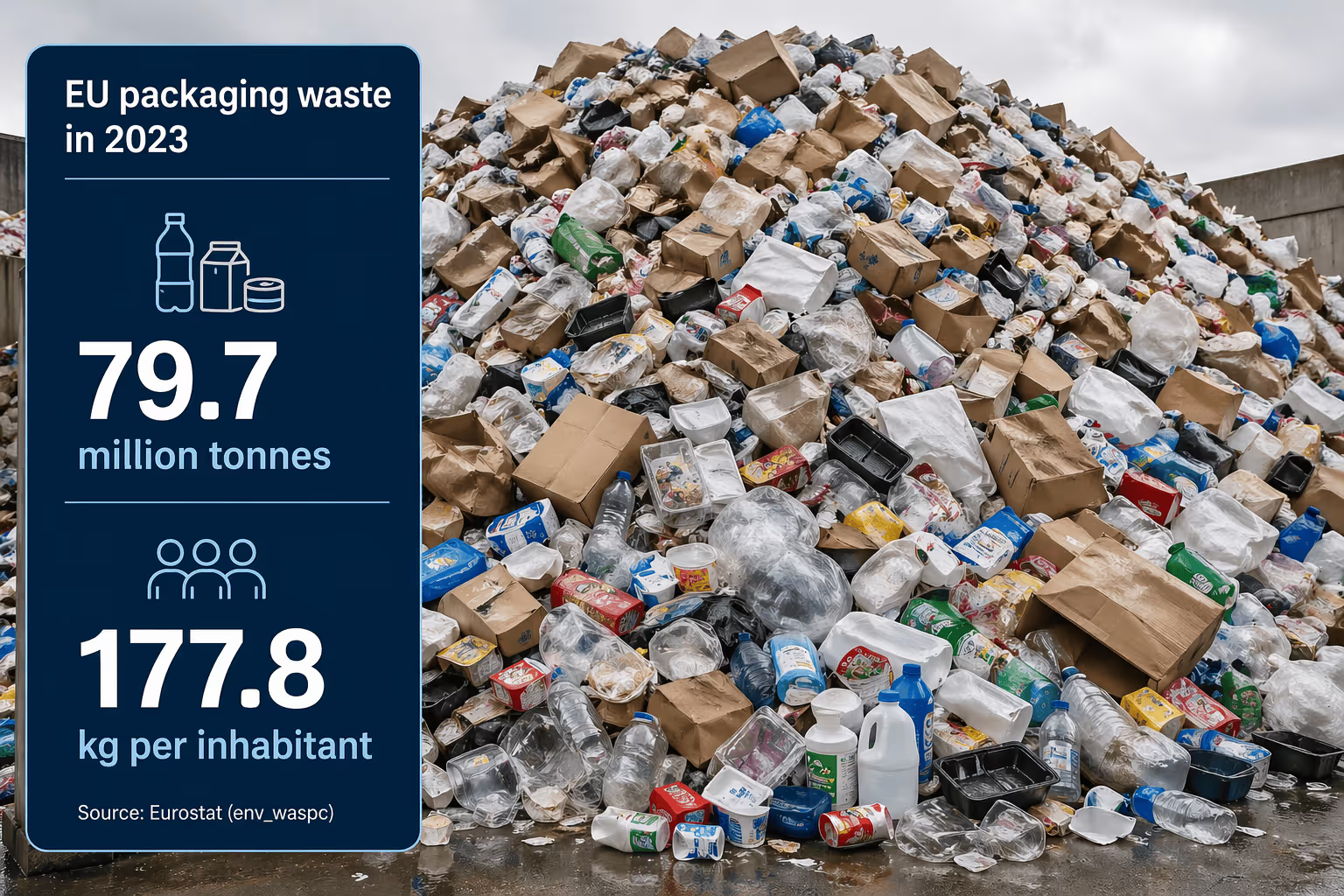
With this new regulation, Europe wants to reduce (plastic) packaging waste and promote reuse of packaging and transport packaging. The reason for this is simple: the scale of the packaging problem is still huge. According to Eurostat, the EU generated 79.7 million tonnes of packaging waste in 2023, or 177.8 kg per inhabitant. Plastic packaging waste alone came to 35.3 kg per person, with 14.8 kg recycled. Those numbers make it pretty clear why Europe is pushing harder on reuse and circularity.
For a long time, reusable packaging was mostly discussed as a sustainability initiative. Important, yes, but still something many companies treated as secondary to day-to-day operations. The PPWR changes that. It turns reuse into something that has to be designed, organized, measured, and eventually proven.
For transport packaging in B2B supply chains, the operational pressure starts from 2030 onward, at which point companies must ensure that at least 40% of their transport packaging is reusable. This includes transport between different companies, but also between sites of the same company. In 2035, this reuse target increases to 70%.
In practice, this means companies cannot stop at “we use returnables.” They need to know how those assets move through a re-use system, how often they turn, and where the process breaks down. We see this as a turning point. Reusable packaging is no longer just a packaging choice. It is becoming an operational system. And operational systems need visibility.
Why is tracking suddenly critical for reusable transport packaging?
With the required reuse targets, it becomes key to have proof and insights in the actual reuse of your transport containers.
The PPWR explicitly connects reusable packaging with trips, rotations, re-use systems, and reporting. For this it foresees a QR code or other digital data carrier for reusable packaging that facilitates tracking and the calculation of trips and rotations, or at least an average estimation where exact counting is not feasible. That is a strong signal. The regulation is not only about the packaging itself. It is also about the data around it.
Tracking will not, by itself, make packaging compliant. It will not replace packaging design rules, hygiene requirements, or mandatory labeling work. But it can provide the operational evidence layer that many teams are currently missing. This is our practical reading of where tracking supports PPWR-related compliance work most directly.
That is why tracking is moving from “nice to have” to infrastructure. If a container goes out and comes back six times, that matters. If it sits for three weeks at a supplier and nobody notices, that matters too. Under PPWR, both start to become compliance questions, not just efficiency questions.
If you want more background on how we approach this problem in practice, we have already covered parts of it in our pages on reusable packaging tracking.
Discover the Pozyx Platform
The Pozyx Platform brings indoor and outdoor positioning data together to provide full asset visibility, automation and location-based insights for logistics and manufacturing.
Pozyx Platform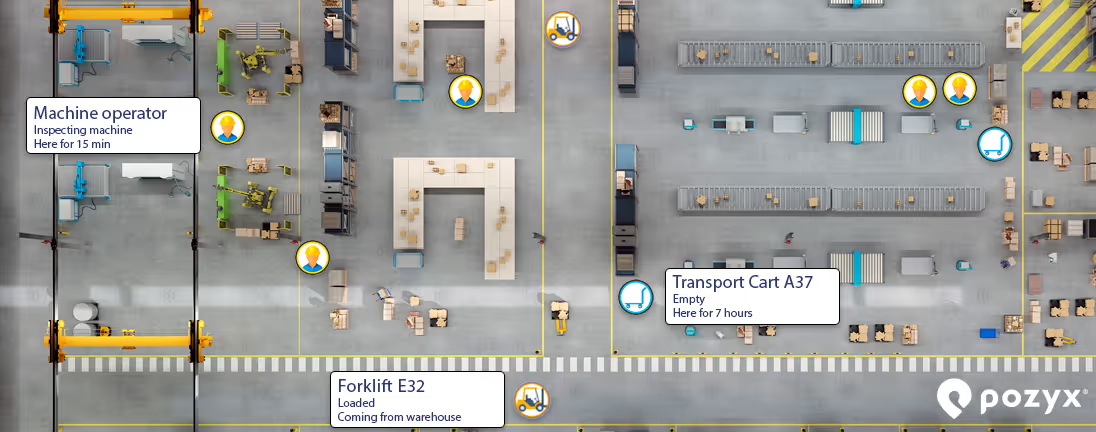
What are the best technologies for tracking transport packaging?
The PPWR now pushes reusable transport packaging in a re-use system toward a QR code or similar data carrier for identification and the tracking of trips and rotations. But that still leaves an important practical question: how do you actually capture the movement of those assets? Most of these assets are non-powered assets. A crate, pallet, rack, or bin does not generate data on its own. The visibility has to come from an identification method, a powered tag, a gateway, or sometimes the truck or forklift moving it. We covered part of that logic before in our article on pallet tracking.
Here are some of the tracking technologies used today for RTI’s:
RFID is strong when you want automated identification at checkpoints or in bulk. Especially with UHF RFID, tags can be read without line of sight and at distances that work well for dock doors, gates, and forklift-mounted readers. It is very good at answering the question: what passed here?
QR codes and barcodes are still the workhorse for manual identification. They are cheap, familiar, and easy to deploy at scale. The downside is obvious too. Someone, or something, still has to scan them.
GPS is the obvious choice when the packaging itself, or the vehicle carrying it, needs to be visible across long distances. For high-value containers or important cross-site flows, battery powered GPS trackers with long battery life give you real-time outdoor location and historical movement data. More on GPS asset tracking.
Bluetooth Low Energy (BLE) sits in the practical middle. BLE tags or beacons can be detected by gateways or scanners in trucks, warehouses, or yards, and they are useful for presence detection, indoor proximity, and flexible low-infrastructure deployments. With the right setup, BLE can also provide zone-level indoor visibility. More on BLE asset tracking.
NFC is the most deliberate option of the five. Its range is extremely short and the interaction is tap-based, which makes it useful for controlled handovers, manual check-in/check-out, and authenticated status updates rather than continuous tracking.
This table is deliberately practical, not academic. Real-world performance depends on the tag, reader, environment, battery settings, and infrastructure. In practice, most serious returnable packaging programs end up combining technologies rather than choosing just one.
How does Pozyx help companies meet the PPWR tracking requirements?
At Pozyx, we see the PPWR challenge as an operational one. Companies do not just need reusable packaging. They need a practical way to identify it, follow it through the reuse loop, and turn that movement data into reporting, insights, and proof.
That is exactly where the Pozyx Platform comes in. We provide one software layer for tracking, visibility, alerts, dashboards, and reporting across indoor and outdoor environments. Underneath that, our omlox-based Location and Sensor Hub brings together location data from multiple sources and technologies into one standardized, vendor-agnostic platform.
At Pozyx, we support different tracking methods for tracking the RTI:
- GPS trackers, for outdoor and inter-site visibility
- BLE trackers, for scalable indoor and proximity-based tracking
- UWB trackers, for highly automated workflows that require accurate UWB-based positioning.
In all cases, we can extend the setup with additional gateways, readers, or infrastructure to create more seamless visibility across yards, warehouses, production sites, and transport flows.
That means we can support use cases such as:
- tracking packaging between suppliers, plants, and customers
- detecting transport indoors through BLE gateways or readers
- adding Wi-Fi or BLE-based indoor visibility to compatible GPS trackers
- creating one continuous view across indoor and outdoor movements
- turning movement history into reports, alerts, and compliance-ready insights
The main benefit is flexibility. We do not believe PPWR readiness starts with forcing one technology everywhere. We start with the tracking approach that makes sense for your packaging flow, then add the right building blocks where more visibility is needed.
With Pozyx, companies can:
- start with a practical returnable packaging tracking project
- scale toward broader indoor-outdoor visibility over time
- avoid lock-in through an omlox-compliant, vendor-agnostic software layer
- use the same location foundation for other applications later on
What will separate PPWR-ready companies from the rest?
The PPWR will not be enforced through policy slides or good intentions. It will be enforced through operations. Companies will need to identify reusable packaging, support the tracking of trips and rotations, and build a more reliable view of how assets move through the reuse system. That makes visibility more than a logistics nice-to-have. It becomes part of how companies prove performance, improve return rates, and prepare for reporting.
That is why we believe the winners will not simply be the companies with the largest returnable packaging pools, but the ones that can show how those assets move, how often they turn, and where delays happen. With the right mix of tracking, software, and reporting, PPWR readiness becomes something practical. And that is exactly where Pozyx helps.
Written by
Samuel Van de Velde

CTO & Co-Founder at Pozyx
Samuel is an electrical engineer with a strong interest in location technology. Skilled in Entrepreneurship, Public Speaking, Product Management, internet of things (IoT), and Machine Learning. After graduating In 2010, he joined the Department of Telecommunications and Digital Information Processing (TELIN) to pursue a Ph.D. degree on the topic of collaborative indoor localisation. In 2015, he founded the spin-off company Pozyx out of that research.