
Pozyx RTLS release v2025.2

We are excited to announce the release of Pozyx RTLS v2025.2, a major update focused on scalability, openness, and more flexible deployments. This release introduces new capabilities that make it easier to deploy and expand RTLS across complex environments, while maintaining reliable performance for indoor location tracking.
Approximate UWB Positioning and Improved Fallbacks
The highlight of RTLS v2025.2 is the introduction of approximate UWB positioning, a key feature that enables more flexible and cost-efficient RTLS deployments without compromising visibility.

With this new capability, the system dynamically adapts to the number and spacing of anchors in each area. High-density ultra-wideband deployments continue to deliver accurate positioning with 10 to 30 cm accuracy. In zones where fewer anchors are available, the system automatically shifts to approximate positioning around 5 m accuracy. When only one anchor is in range, it provides presence detection, confirming whether an asset is nearby.
This tiered accuracy model allows for lower infrastructure density in non-critical zones, while maintaining full asset visibility across the site. It is ideal for phased deployments, cost-sensitive expansions, and hybrid indoor-outdoor tracking.
Native omlox Hub Connector
The key highlight of RTLS v2025.2 is the introduction of a native omlox hub connector.
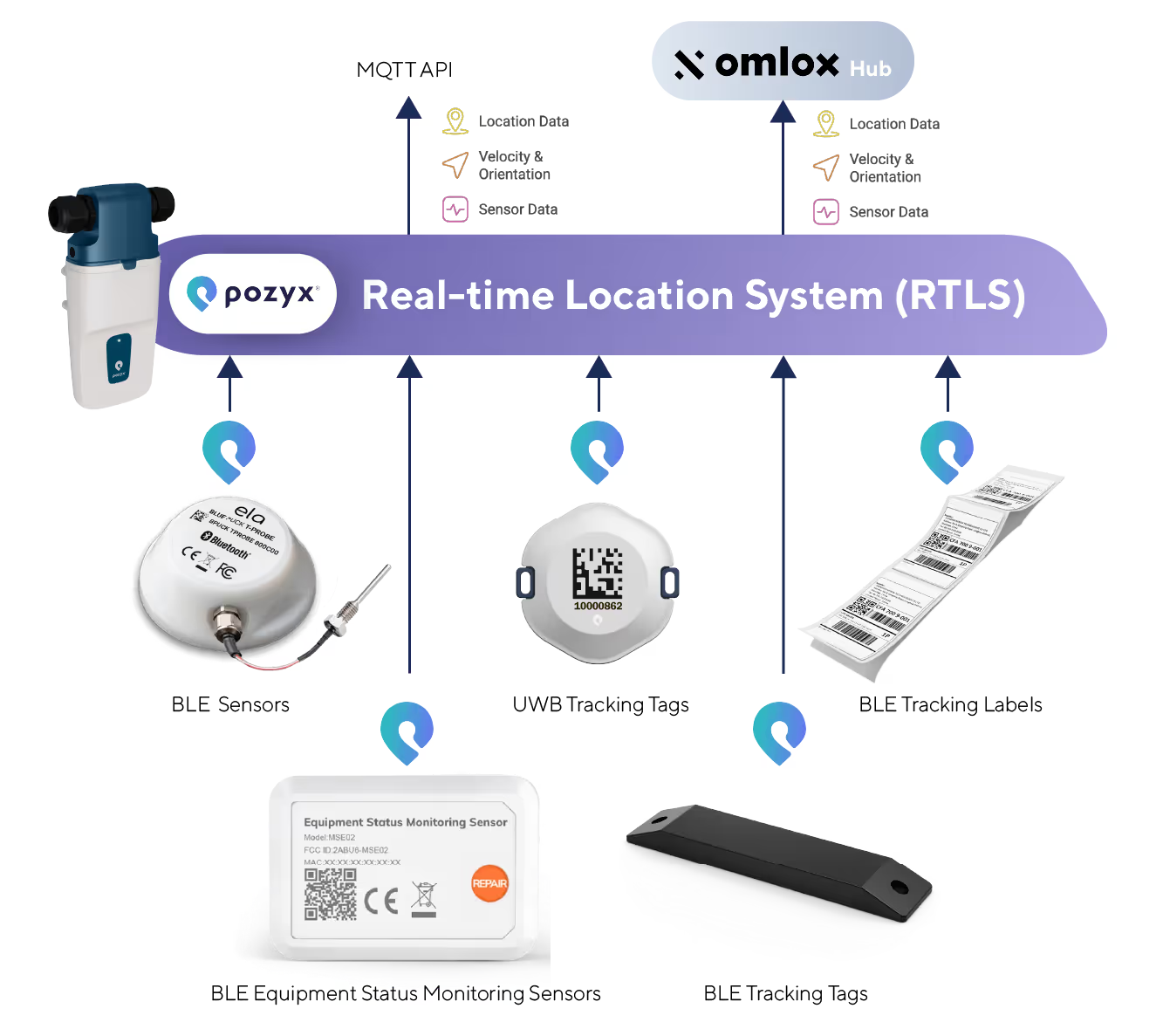
With this new connector, the Pozyx RTLS can now easily connect to any omlox hub, enabling interoperability through the open omlox standard. This makes it possible to use a single RTLS system to cover multiple buildings, areas, and floors by connecting to different omlox zones.
For customers operating across large sites or multiple locations, this significantly reduces integration effort and simplifies system architecture. Location data can be distributed consistently to enterprise applications while keeping the flexibility to combine different location technologies and vendors.
Stay in the loop!
Stay up to date with the latest Pozyx and Industry news on Real-Time Location Tracking. Don’t miss out! No spam, promise.
Yes, sign me up
Improved Static Tag Performance
Static assets such as pallets, tools, or containers often face challenging conditions like vibrations, metal interference, and limited signal availability.
In this release, we have further improved the static tag detection logic, combining UWB measurements with sensor data to better determine when assets are stationary. While static tag handling has been available for some time, this update delivers more stable and accurate positioning in demanding industrial environments.
Better Platform Integration, Security, and Stability
RTLS v2025.2 also brings tighter integration with the Pozyx Platform, making configuration, monitoring, and day-to-day operation more streamlined.
In addition, this release includes multiple security improvements and bug fixes that further strengthen system robustness and reliability for enterprise deployments.
Built for Scale, Today and Tomorrow
RTLS v2025.2 is another step toward a more flexible, interoperable, and scalable RTLS platform. It enables faster rollouts, easier expansion, and better alignment with open standards like omlox.
We are continuously improving the Pozyx RTLS system and already have exciting features in development for the 2026 release. Feedback from customers and partners plays a key role in shaping our roadmap, so if you have ideas or feature requests, we would love to hear from you.
Written by
Samuel Van de Velde

CTO & Co-Founder at Pozyx
Samuel is an electrical engineer with a strong interest in location technology. Skilled in Entrepreneurship, Public Speaking, Product Management, internet of things (IoT), and Machine Learning. After graduating In 2010, he joined the Department of Telecommunications and Digital Information Processing (TELIN) to pursue a Ph.D. degree on the topic of collaborative indoor localisation. In 2015, he founded the spin-off company Pozyx out of that research.